
What precautions should be taken when using the ABB excitation control unit 3BHE041343R0102 PCD530A102?
Date: Nov 28, 2025Views:
3BHE041343R0102 PCD530A102 Excitation Control Unit (ABB) Usage Precautions and Operating Procedures
Installation and Environmental Adaptability
Physical Installation:
Rack Requirements: Must be installed in an industrial rack meeting IP20/IP21 protection standards, ensuring sufficient heat dissipation space (operating temperature 0~60℃, -40~70℃ wide temperature range optional), avoiding high temperature, high humidity, or strong electromagnetic interference environments.
Grounding and Lightning Protection: Grounding resistance ≤1Ω, equipped with a surge protector (SPD) to prevent damage to the equipment from lightning strikes or power grid surges; a filter must be installed at the power input to suppress harmonic interference.
.jpg)
Power Supply Configuration:
Power Supply Stability: 24V DC logic power supply voltage fluctuation ≤±5%, it is recommended to equip redundant power modules (such as dual power automatic switching devices) to avoid system downtime due to single point of failure.
Power Supply Isolation: Use isolation transformers or DC/DC modules to achieve electrical isolation between power supply and signal circuits to prevent common-mode interference from affecting control accuracy.
Communication and Network Configuration
Protocol Compatibility:
Supported Protocols: Ethernet/IP, Modbus TCP/RTU, Profinet, IEC 61850 MMS/GOOSE, compatible with OPC UA standards. Communication parameters must be consistent with the host (e.g., DCS/PLC) (e.g., IP address, subnet mask, baud rate).
Redundancy Configuration: Enables dual-channel hot standby mode. Data synchronization period between primary and backup channels is ≤1ms. Automatic switching occurs in case of failure (switching time ≤20ms) to ensure communication continuity.
Network Topology:
Fiber Optic Redundant Ring Network: Supports fiber optic communication boards (e.g., PCD530A102 fiber optic communication board) to meet long-distance data transmission requirements. A ring topology is used, ensuring that a single point of failure does not affect overall communication.
Industrial Switches: Industrial switches supporting VLAN segmentation and QoS priority management are selected to avoid data delays caused by network congestion.
Operation and Function Configuration
Excitation Control Logic: Implements closed-loop regulation of the generator rotor excitation current based on a PID algorithm, maintaining terminal voltage fluctuations ≤ ±0.5%. Supports multiple control modes including constant voltage, constant power factor, and constant reactive power. Tuning is required based on generator parameters (e.g., excitation current range 1.0kN).
Communication Protocol Compatibility: Integrates industrial protocols such as Ethernet/IP, Modbus TCP/IP, Profibus-DP, and IEC 61850. Supports the OPC UA standard and can seamlessly connect to DCS/SCADA systems (e.g., ABB 800xA) and third-party devices. Compatibility between communication interfaces (e.g., Ethernet, RS485/RS232) and the host computer must be verified to avoid signal conflicts.
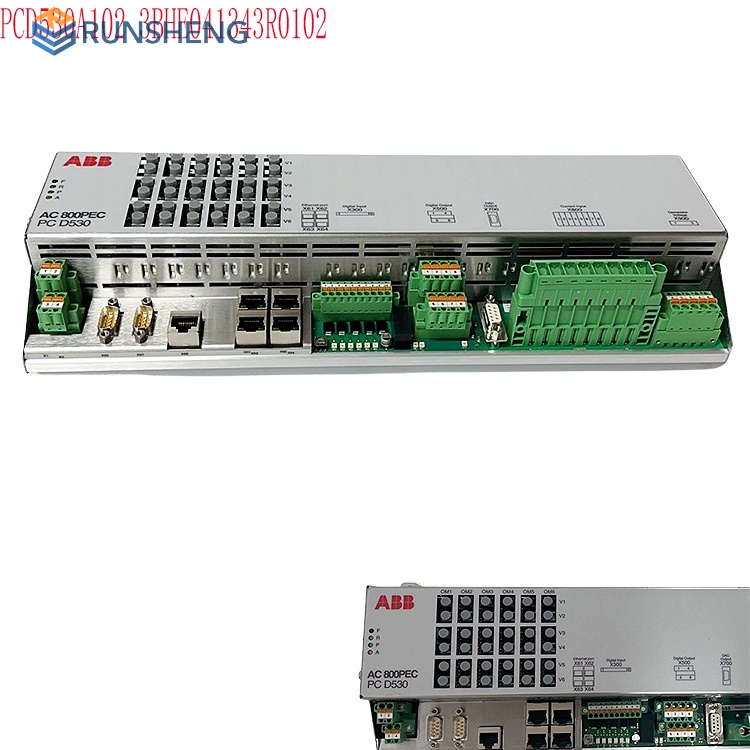
Redundancy and Self-Diagnosis: Employs a dual-channel redundancy design with a primary/backup channel switching time ≤ 20ms. Built-in self-diagnostic functions (e.g., COMTRADE fault recording) monitor voltage/current parameters in real time, trigger protection actions (e.g., overvoltage/undervoltage, overcurrent), and locate faults via LED status lights or system logs. Modular Expansion: Supports integration with ABB I/O modules (such as the S800/S900 series) and safety function modules (such as emergency stop modules) to build a complete control system; ensure that the electrical parameters (such as voltage and current) of the expansion modules are compatible with the main controller.
Parameter Setting and Drive Logic
Excitation Control Algorithm:
PID Parameter Optimization: Adjust the proportional gain (P), integral time (I), and derivative time (D) according to the generator capacity (such as a 1.0kN range) to optimize dynamic response (such as rise time and overshoot).
Control Mode Selection: Supports switching between constant voltage, constant power factor, and constant reactive power modes; priority must be configured according to grid demand (e.g., constant voltage mode is prioritized when grid-connected, and constant reactive power mode is switched when in islanded mode).
Protection Threshold Settings:
Electrical Protection: Set protection values for overvoltage/undervoltage (e.g., ±10% of rated voltage), overcurrent (e.g., 1.5 times rated current), and frequency abnormality (e.g., 50±0.5Hz). Upon triggering, execute rapid demagnetization and circuit breaker tripping.
Mechanical Protection: Monitor module temperature (e.g., ≤85℃), fan speed, and access control switch status. Trigger alarms or shutdown upon abnormalities.
System Integration and Collaborative Operation
Generator Interlocking:
Pulse Trigger Control: Generate thyristor/IGBT rectifier bridge trigger signals via a pulse trigger board (PTB) to control the excitation current output; the linear relationship between the trigger angle and excitation current needs to be calibrated to ensure accuracy ≤±0.5%.
Synchronization and Grid Connection: Work with the GBU72 distribution cabinet system to achieve grid-side synchronous detection, ensuring coordination between circuit breaker closing/opening and excitation regulation, avoiding grid inrush current.
Governor/DCS Integration:
Dynamic Balancing: Collaborates with the turbine governor to optimize dynamic balance between power generation and load, supporting rapid excitation recovery in black-start scenarios.
Remote Monitoring: Communicates with the DCS/PLC system via OPC UA or IEC 61850 protocol to achieve remote parameter adjustment, status monitoring, and fault early warning.
Maintenance and Troubleshooting:
Regular Inspections:
Hardware Inspections: Monthly inspections of power modules, connection lines, and communication interfaces; quarterly cleaning of the cabinet to ensure unobstructed cooling.
Software Maintenance: Annual firmware upgrades (obtain the latest version through ABB official channels), and performance calibration (e.g., excitation current accuracy testing, communication latency testing).
Fault Diagnosis:
Self-Diagnostic Function: Utilizes COMTRADE fault recording and LED status indicators (RUN/ALARM/TRIP) to quickly locate fault points (e.g., communication interruption, excitation current drift).
.jpg)
Common Problem Handling:
Communication Interruption: Check network topology, IP address configuration, and fiber optic connections; restart communication modules or switches.
Excitation Current Fluctuation: Calibrate PID parameters, check excitation winding insulation resistance, and eliminate external interference sources.
Protection False Trigger: Verify protection threshold settings, check sensor accuracy, and eliminate hardware faults.
Safety and Compliance
Electromagnetic Compatibility: Passes IEC 61000-4 standard EMC testing; immunity to interference meets industrial environment requirements (e.g., surge, electrostatic discharge, radio frequency interference).
Functional Safety Certification: Complies with IEC 61508/61511 standards, supports SIL 2/3 certification, ensuring safe system operation.
Operating Safety Procedures:
Power Deactivation: Before maintenance, power must be disconnected and no residual voltage confirmed. Use insulated tools and protective equipment (e.g., anti-static wrist straps, safety glasses).
Access Control: Set multi-level user access permissions to prevent unauthorized personnel from modifying critical parameters or performing dangerous operations.
In summary, the PCD530A102 3BHE041343R0102 excitation control unit requires
close attention to the installation environment, power supply configuration,
communication settings, parameter optimization, system integration, and safety
specifications. Through rigorous installation, configuration, and maintenance
procedures, combined with self-diagnostic functions and remote monitoring,
efficient and reliable system operation can be ensured, reducing the risk of
unplanned downtime.
Recommended related products:
3BSE031151R1 PM865K01
3BSE031151R1 PM865K01
3BSE030193R1 PM865
PM858K02 3BSE082896R1
PM865AK01 3BSE031150R1
PM865K01 3BSE031151R1
PM802F 3BDH000002R1
PM803F 3BDH000530R1
PM820-1 3BSE010797R1
PM820-2 3BSE010798R1
PM825 3BSE010796R1
PM825-1 3BSE010800R1
PM858-C 3BSE093350R1
PM861AK01 3BSE018157R1
PM861K01 3BSE018105R1
PM864AK01 3BSE018161R1
PM864AK01-eA 3BSE018161R2
PM864A PM861A 3BSE018162R1
PM866 3BSE050200R1
PM866AK02 3BSE008538R1
PM866-2 3BSE050201R1
PM866AK02 EXC3BSE076939R
PM866K01 3BSE050198R1
PM891K02 3BSE053242R1
PM891K01 36BSE053241R1
PM891 3BSE053240R1
More......
RELATED ARTICLE
PLC Dragon Automation
Address: Wanda Plaza, Chengdu, Sichuan Province
Google email: wkcarshop666888@gmail.com
Industrial Control Sales Consultant: Amelia
Whatsapp: +86 18030295882
12A3256BC9DA41BAB264DB676273DA32.png)


3BE7E049824E4F11BE61AD65D86DFEBD.png)