
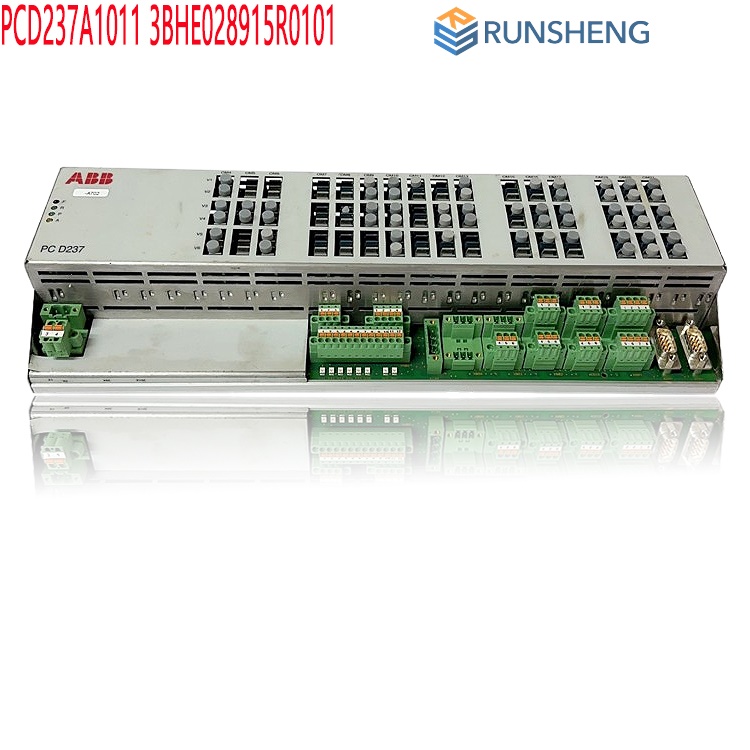
Precautions for using PCD237A101 3BHE028915R0101 Central Excitation Processor
Date: Mar 09, 2026Views:
I. Pre-operation Preparation and Inspection
Power Supply and Wiring Confirmation
Ensure the control cabinet power supply (AC/DC) is switched on. DC power (e.g., 110V DC power supply) must be supplied in two independent sections (Section I/Section II) to avoid single-point failure.
Check the phase sequence on the low-voltage side of the excitation transformer (must conform to the sequential sequence L1-L2-L3). Ensure the input/output three-phase voltages of the synchronization transformer are balanced, fuses are not blown, and wiring terminals are not loose.
.jpg)
Equipment Status Inspection
Manually test the fan's rotation direction (upward exhaust) and ensure there are no abnormal noises. Automatic start-up conditions are: excitation current > 80A or terminal voltage > 50% of rated voltage.
The demagnetizing switch and anode disconnect switch must be in the correct positions (the anode disconnect switch does not need to be disconnected during normal shutdown, only during maintenance). The demagnetizing switch closing signal must be confirmed through the auxiliary contacts.
II. Operating Procedures
Start-up Procedure
When the unit speed reaches 90% or more of the rated speed (frequency ≥ 45Hz), briefly press the "Activate Excitation Switch" button, then press the "Activate Excitation" button to automatically increase the voltage to the given value (e.g., 6000V). Fine-tune the voltage using the "Increase/Decrease Excitation" function until the system voltage is consistent, and wait for synchronous grid connection.
After grid connection, adjust the reactive power using the "Increase/Decrease Excitation" function. Active power must be adjusted synchronously to maintain a power factor ≥ 1, avoiding leading-edge operation (when leading-edge operation occurs, check the stator end temperature, plant auxiliary voltage, and stator current overload risk).
Shutdown Procedure
Normal Shutdown: First reduce active power (decrease governor opening) and reactive power (decrease excitation) to no-load. Press the "Decrease Excitation" button to reduce the unit terminal voltage and excitation current to zero. Finally, disconnect the excitation switch (to extend switch life).
Emergency Stop: Triggering the "Emergency Stop" function (IEC 60204 standard) achieves either a Class 0 stop (immediate power cut-off) or a Class 1 stop (power cut-off after controlled speed reduction) via the Safe Torque Off (STO) function.
III. Operational Safety Specifications
Personnel Qualifications and Protection
Electrical installation, commissioning, and maintenance must be performed by qualified electricians. Before operation, safety shoes, insulated gloves, and other personal protective equipment must be worn, and safety training (e.g., IEC 60204 standard) must be completed. Do not open the cabinet door while the equipment is running. Do not operate the equipment while the amber warning light is flashing; wait 5 minutes for the intermediate circuit capacitors to fully discharge (voltage drops below 30V DC).
Power Management
The power supply uses a 24V DC industrial power supply with redundant design. Before operation, all voltage sources (PWR L1-L3, AUX L1-L3) must be disconnected and locked with tags (LOTO) to prevent reconnection. Inrush current must be controlled below 200A and last for ≤10ms to avoid damaging the power modules.
.jpg)
IV. Environmental and Installation Requirements
Environmental Adaptability
Standard operating temperature: 0°C to +60°C for the standard model; -40°C to +70°C for the wide-temperature model. Must be installed in an IP20 protection-rated control cabinet, avoiding strong electromagnetic fields, acidic fumes, and volatile gas environments. Vertical installation ensures smooth airflow and heat dissipation. A clearance of ≥50mm/20mm should be provided at the top/bottom of the cabinet, and a gap of ≥10mm should be left on both sides.
Interference Resistance and Grounding
Electromagnetic interference resistance design is adopted. Control cables and excitation cables must be wired separately (spacing ≥30cm). Grounding requires a ≥4mm² copper conductor, using a toothed washer to achieve a low-impedance connection (≤1MΩ) to avoid static electricity accumulation (do not wear synthetic material clothing; touch the grounded metal to discharge static electricity before operation).
V. Maintenance and Troubleshooting
Regular Maintenance Plan
Excitation System Status Monitoring: Includes alarm handling for PT disconnection, excitation failure, overspeed/underfrequency demagnetization, reactive power limitation, and fan failure. Analysis must be performed using event logs (≥1000 entries) and fault waveforms (COMTRADE format).
Rectifier Bridge Fuse Inspection: If a fuse blows, confirm whether it was caused by overcurrent. Check the tightness of the thyristor screws, cable insulation (≥1000V megohmmeter test), and transformer condition.
Grounding Protection Device Testing: Using the bridge principle, Section I (2000Ω, 5s) and Section II (500Ω, 2s) require periodic calibration.
VI. Software and Firmware Management
Firmware upgrades are performed using ABB Control Builder M tool, compatible with AC800M series I/O modules. Configuration files must be backed up.
Parameter Settings: Values such as "Advancing Phase Constant" (setting 1000 represents 10MVar) and "Reactive Power Limit" need to be adjusted according to generator performance, modified through the excitation regulator menu (e.g., menu 10/11).
Daily Inspection: Check equipment sound, odor, and temperature every shift (infrared thermometer monitors copper busbar/demagnetizing switch contact temperature; normal voltage drop ≤ 80mV); clean filters and cooling ducts monthly, using a vacuum cleaner/blower along the airflow direction to avoid dust accumulation.
Quarterly Maintenance: Check the tightness of all electrical connections (torque wrench verification); test relay/contactor DC resistance and operational reliability; verify the demagnetizing resistor (measure resistance value for linear resistors, test varistor characteristics with a megohmmeter for silicon carbide/zinc oxide resistors).
Annual Overhaul: Perform insulation resistance testing (250V/1000V/2500V megohmmeter graded testing), AC withstand voltage test (1000-5000V for 1 minute), and replace aged seals and cooling fans.
Troubleshooting
Fault codes are read via the status LED/alarm display panel, supporting self-diagnostic functions (such as overvoltage F02, undervoltage F05, brake power over-limit n02, etc.). When replacing printed circuit boards or SCRs, ESD protection specifications must be followed, using anti-static packaging and grounding wrist straps; the modular design supports hot-swapping, with a switching time ≤200ms.
VII. System Integration and Communication
Compatibility and Expansion
Supports ABB 800xA, AC800M DCS systems and third-party SCADA platforms (via IEC 61850, Modbus RTU, CAN, etc. protocols); modular stacking expands the number of I/O points, compatible with modules such as the PCD231A101 in the same series, allowing for mixed deployment to achieve system expansion.
Data Monitoring and Diagnosis
Built-in event logging (≥1000 entries), fault waveform recording (COMTRADE format), and status monitoring functions; firmware upgrades are achieved through the Control Builder M tool (requires compatibility with the AC800PEC hardware platform). Supports remote centralized monitoring and OPC UA data communication, enabling automatic reactive power/power factor adjustment and PSS function to enhance grid transient stability.
VIII. Safety Specifications and Fault Handling
Safety Operation Requirements
Operators must wear insulated protective equipment. It is forbidden to plug or unplug terminals while they are energized. In emergencies, the machine can be stopped immediately using the "Emergency Stop" button or the "Safety Torque Off" function.
Channel switching requires that the backup channel is fault-free and the operating channel is being tracked. After switching, it must be confirmed that the UGR/IFR/ARF values are consistent (with minimal error).
Common Fault Handling
PT Disconnection: Automatically switches to constant current operation. Check the PT secondary side wiring, fuses, and synchronous transformer output. After restoration, it automatically returns to the original operating mode.
Excitation Failure: Check the demagnetizing switch closing signal, rotor grounding, excitation circuit (DC power supply/excitation resistor/diode/contactor), and generator frequency (≥45Hz).
Overspeed/Underfrequency Demagnetization: Automatic demagnetization occurs when the frequency is >70Hz or <45Hz. The "Frequency Fault" control word setting on the speed controller and excitation regulator needs to be checked (1 for enabled, 0 for disabled).
Loss of Excitation Protection: Triggered when the excitation voltage is <0.2 times the rated value. The rectifier fault, pulse amplifier board, and rotor grounding need to be checked.
Environmental and Interface Requirements
Environmental Conditions: Operating temperature 0°C to +60°C (wide-temperature model -40°C to +70°C), IP20 protection rating, electromagnetic interference (EMI) resistant design; avoid strong electromagnetic fields.
Communication Interface: Supports industrial Ethernet, RS485 (Modbus RTU), and IEC 61850 protocols; seamlessly interfaces with ABB 800xA, AC800M DCS, third-party SCADA, or ABB Ability™ platforms.
IX. Special Scenarios and Precautions
High Altitude/High Temperature Environments: The excitation current compensation coefficient needs to be calibrated to prevent over-excitation and core overheating; the cooling system needs to be equipped with an external exhaust duct and redundant filter design.
Corrosive Environments: The cabinet must be made of 304 stainless steel, and connectors should use nickel-plated/gold-plated contacts to avoid poor contact caused by sulfide corrosion.
Emergency Stop: After triggering the emergency stop button, the Safety Torque Off (STO) function will take effect immediately, cutting off the excitation output and locking the restart; a safety circuit (compliant with IEC 62061 SIL CL2/ISO 13849-1 PLd) must ensure that the fault path is completely disconnected.
Summary: The use of the PCD237A101 3BHE028915R0101 central excitation processor must strictly follow the operating procedures, maintenance cycles, and safety specifications. Real-time status monitoring and fault diagnosis are necessary to ensure stable system operation. Firmware updates and protection device verification are also required regularly to ensure equipment safety and system performance in scenarios such as power generation and industrial process control.
Recommended related products:
ABB 3BSE018153R1 PM864K02
ABB 3BSE018168R1 PM851K01
3BSE018103R1 CI853
3BHE023784R2630 PP D113 B01-26
UAC095AE01 HIEE300788R0001
3BHE023784R2530 PPD113B01
3BSE031151R1 PM865K01
3BSE023409R20 PFCL201C 20KN
3BSX802939-108 PFCL201CE 50KN
3BHB009884R0002 S-073H
3BHB009884R0004 S-073H
3BHB009884R0013 S-073M
3BHB009884R0052 S-073H
3BHB009884R0204 S-073H
3BHB009885R0002 S-093H
3BHB009885R0004 S-093H
3BHB009885R0014 S-093M
3BHB009885R0031 S-093S
3BHB009885R0104 S-093H
3BHB030479R0512 S-123H
3BHB030477R0207 S-073H
3BHB030478R0309 S-093H
3BHB006457R0001 S-093N
3BHB009885R5311 S-093N
3BHB009885R0001 S-093N
3EHL409300R1 PPB626B01
3EHL409300R0001 PPB626B01
3BSX670292-112 PFVL141C-60MN
3BSX670292R3000 PFVL141C-60MN
More......
RELATED ARTICLE
PLC Dragon Automation
Address: Wanda Plaza, Chengdu, Sichuan Province
Google email: wkcarshop666888@gmail.com
Industrial Control Sales Consultant: Amelia
Whatsapp: +86 18030295882
12A3256BC9DA41BAB264DB676273DA32.png)


3BE7E049824E4F11BE61AD65D86DFEBD.png)