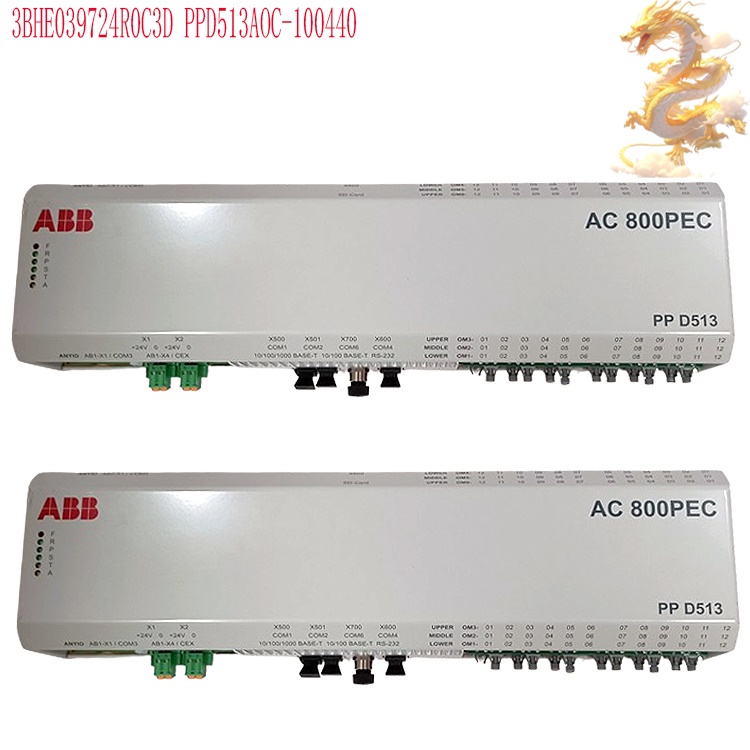
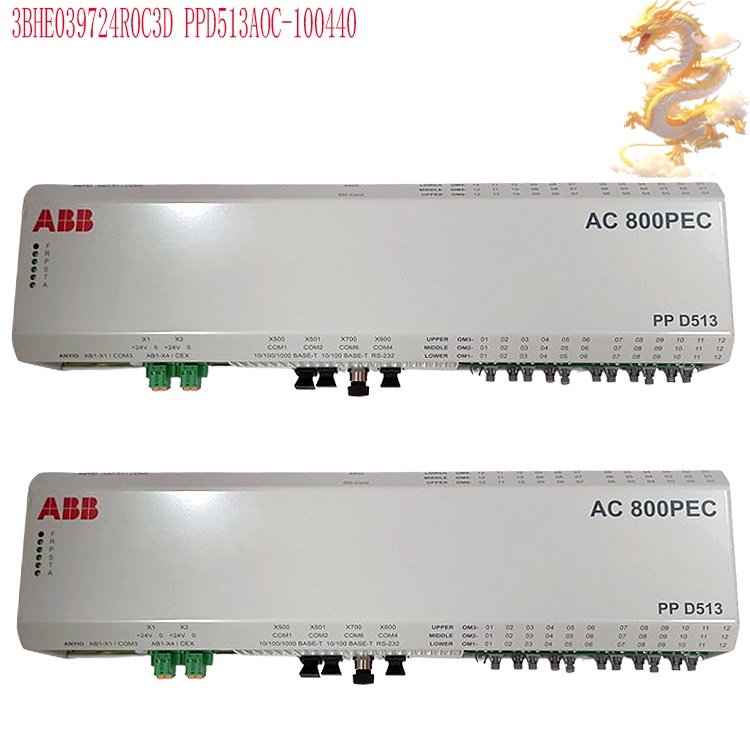
PPD513A0E-110110 | Excitation Processing Unit | ABB | 3BHE039724R0E41 | PPD513
Employing a dual-core processor architecture, it supports parallel processing with control algorithm cycle times as low as 100 microseconds, making it suitable for fast control loops (such as synchronous generator excitation regulation). Integrating FPGA technology, it achieves efficient processing of protocol and application functions without increasing processor load. It supports industrial protocols such as Modbus TCP/IP, Profibus-DP, and IEC 61850, and is compatible with Ethernet and RS485/RS232 interfaces, allowing integration with DCS/SCADA systems. Equipped with 128MB of memory, it supports high-speed data transmission interfaces (Ethernet, USB, RS232/485, optical link) and is compatible with industrial protocols such as Modbus TCP/IP, Profibus-DP, and IEC 61850, enabling seamless integration into DCS/SCADA systems.
.jpg)
.jpg)
Many products are not yet listed. Please contact us for more product information.
If the product model differs from the displayed image, the model number shall prevail. Please contact us for specific product images; we will arrange to take photos in our warehouse for confirmation.
We have 76 shared warehouses worldwide, so it may sometimes take several hours to return an accurate result. We apologize for any inconvenience. Of course, we will respond to your inquiries as soon as possible.
Other
names for PPD513A0E-110110 3BHE039724R0E41:
Excitation Communication Unit PPD513A0E-110110 3BHE039724R0E41
PPD513A0E-110110 3BHE039724R0E41 Analog Unit
Input/Output Unit PPD513A0E-110110 3BHE039724R0E41
Product Positioning and Core Functions
AC 800PEC Controller: A core product of ABB industrial automation, designed specifically for high-power rectifiers, generator excitation systems, and industrial process control. It adopts a dual-core processor architecture, supports 100-microsecond fast control cycles, and integrates high-speed and low-speed control tasks (such as PID algorithms and real-time logic operations), reducing reliance on independent PLCs. Excitation Processing Unit Characteristics: As the core of the excitation system, it is responsible for regulating the excitation current, stabilizing the terminal voltage, controlling reactive power, and improving dynamic stability of the synchronous generator/motor. Typical applications include thermal power, hydropower, nuclear power, and industrial motor excitation control (such as rolling mills and electric furnaces).
Excitation Control: Precisely adjusts the generator rotor excitation current through a PID algorithm to stabilize the terminal voltage, control reactive power, and improve the dynamic stability of the power system.
.jpg)
Pulse Trigger: Integrates a pulse trigger board (PTB) function to generate thyristor/IGBT trigger signals, control the rectifier bridge output, and ensure stable operation of the excitation power unit.
Protection and Monitoring: Real-time monitoring of parameters such as voltage, current, and temperature; supports overvoltage/undervoltage/overcurrent protection, over-temperature alarm, insulation fault detection, and fault diagnosis.
Communication and Expansion: Supports industrial protocols such as Modbus TCP/IP, Profibus-DP, and IEC 61850; compatible with Ethernet and RS485/RS232 interfaces; can be integrated with DCS/SCADA systems.
Processor and Cycle Time: Employs a dual-core processor architecture, supporting parallel processing with control algorithm cycle times as low as 100 microseconds, suitable for fast control loops (such as synchronous generator excitation regulation). Integrated FPGA technology enables efficient processing of protocol and application functions without increasing processor load.
Development Tools: Supports IEC61131-3 language (via ABB Control Builder) and MATLAB/Simulink for model-based control development, enabling a rapid transition from simulation to implementation.
Redundancy Design: Supports dual-channel redundant configuration, with independent operation of primary and backup modules and automatic switching in case of failure (switching time ≤200ms), ensuring system continuity.
Technical
Parameters and Structural Features
Hardware Configuration:
Processor: Multi-core CPU + FPGA architecture, supporting parallel processing and protocol embedding (such as Profibus, Ethernet/IP), avoiding additional processor load.
Communication Capabilities: Optical link (fiber optic) enables fast I/O transmission, supporting Ethernet, RS232/485, USB, and industrial buses (such as Modbus TCP, IEC 61850).
Power Supply and Protection: 24V DC power supply, industrial-grade hardware design (anti-electromagnetic interference, high temperature/high humidity resistance), IP20 protection rating, supports hot-swapping and redundant configuration.
Memory and Communication: Equipped with 128MB memory, supports high-speed data transmission interfaces (Ethernet, USB, RS232/485, optical link), compatible with industrial protocols such as Modbus TCP/IP, Profibus-DP, and IEC 61850, and can be seamlessly integrated into DCS/SCADA systems.
Interface Specifications:
Digital I/O: 32-channel digital input (DI)/output (DO), supports 24V/48V DC, scan cycle 25μs.
Analog I/O: 12-bit precision analog input (AI, ±10V/±20mA) and analog output (AO, ±10V), used for acquiring parameters such as excitation voltage/current and terminal voltage.
Temperature Monitoring: 3-channel PT100/PTC sensor interface for monitoring the temperature of the excitation winding and rectifier bridge heatsink.
Communication Interfaces: Dual 10/100BASE-TX Ethernet ports, RS485/RS232, fiber optic communication (supports redundant links, latency ≤100μs).
Environmental Adaptability:
Operating temperature range -40℃~+70℃, protection rating IP20/IP67, electromagnetic interference resistant design, suitable for harsh industrial environments.
Redundant power supply design (dual 24V DC input), supports hot-swapping and fault switching, ensuring continuous operation.
Functional Characteristics and Protection Mechanisms:
Excitation Control: Precisely adjusts the generator rotor excitation current through a PID algorithm, stabilizing the terminal voltage, controlling reactive power, and improving the dynamic stability of the power system. Supports self-excited/excited topologies, adaptable to 10MW~1000MW synchronous generators.
Protection Functions: Integrated overcurrent, undervoltage, overvoltage, and overtemperature protection packages, supporting predictive maintenance. In case of a fault, a controllable shutdown (not immediate tripping) is triggered, reducing production disruption.
Monitoring and Diagnosis: Real-time acquisition of parameters such as excitation voltage/current, terminal voltage, and rotor temperature is achieved through digital/analog I/O interfaces (e.g., 12-channel DI, 16-channel DO, 3-channel AI/AO) to realize closed-loop control. Supports potential line-to-ground resistance measurement (PERMS) and insulation fault monitoring.
Software and Tools:
Programming Environment: Supports IEC 61131-3 standard languages (e.g., function block diagrams, ladder diagrams) and ABB Control Builder tools, compatible with MATLAB/Simulink for model-based design.
System Integration: Seamlessly integrates with the ABB Ability 800xA system, supporting global database, web self-diagnosis, and remote monitoring functions.
Protection Functions: Built-in overvoltage, undervoltage, overcurrent, and open-circuit protection packages, supporting predictive maintenance and fault diagnosis (e.g., rotor grounding fault detection).
Rail Transit: Applied to servo control of traction drive and door/braking systems.
Renewable Energy: Supports grid-connected control of wind and solar power, improving grid flexibility.
Typical
Application Scenarios
Power Industry: Generator excitation control (self-excited static excitation system), grid stability regulation, electric arc furnace electrode control.
Industrial Automation: Metallurgy (rolling mill), Chemical Industry (reactor), Papermaking (tension/speed control), Machinery Manufacturing (CNC machine tools, robots).
Energy Management: Synchronous motor reactive power compensation, DC voltage regulation, power factor optimization.
Installation
and Maintenance
Installation Method: DIN rail or rack slot installation, supports modular expansion and hot-swappable maintenance.
Maintenance Points:
Regularly clean heat dissipation channels, check power supply and communication connections, and calibrate analog channels every six months.
Monitor relay contact status to prevent sticking; redundant modules require regular switching tests to verify hot standby functionality.
Follow operating procedures to prevent unexpected shutdowns and ensure the operating environment meets temperature and humidity requirements.
Compatibility
and Expandability
Modular Design: Supports third-party Anybus-S fieldbus modules (such as ProfiBUS, CANopen), allowing flexible expansion of I/O points and communication interfaces.
Compatibility: Fully integrated with ABB Ability System 800xA, compatible with UNITROL 6000/5000 series excitation systems, supporting seamless replacement of older modules (such as UN6000 3BHE023784R2630 PP D113).
.jpg)
Expansion Interfaces: Fiber optic link (delay ≤100μs), RS485 bus, Bender relay interface, supporting multi-device collaborative control.
Part
Number Analysis
PPD513A0E-110110 3BHE039724R0E41: Belongs to the ABB part numbering system and may correspond to a specific module (such as a controller module, I/O board, or excitation regulation unit). For example:
PPD513A0E-110110 (Part No. 3BHE039724R0E41): Industrial controller, supporting multi-channel I/O and complex algorithms.
GFD563A101 (Part No. 3BHE046836R0101): Excitation control unit, used for synchronous motor voltage regulation and stability control.
UN 6000 (Part No. 3BHE026284R0102): Core module of the excitation system, integrating pulse triggering, protection, and communication functions.
Extended
Information
Compatibility and Expandability: Supports modular expansion (such as S800 I/O modules), compatible with third-party devices (such as Siemens, Rockwell), and supports redundant configurations (CPU, power supply, communication modules).
Maintenance and Upgrades: Industrial-grade hardware design ensures long-term stable operation, supports online firmware updates and remote diagnostics, reducing downtime.
Summary: The PPD513A0E-110110 3BHE039724R0E41 AC 800PEC excitation unit is a core component of ABB's industrial control systems. With its high-performance processing capabilities, high reliability design, and rich interface configuration, it is widely used in power, metallurgy, petrochemical, and rail transportation industries, and is a key device for ensuring stable generator operation and dynamic balance of the power system.
All products on this website are special
products, and market prices are constantly fluctuating.
Please refer to customer service for a quote, as the price is not accurate as it is for new products.
Please confirm the model, product, price, and other detailed information with customer service before placing an order. This website is currently in use.
New products are available for sale; please contact customer service for further information.
Discounted
product recommendations:
PPD517A3011
3BHE041576R3011
PPD517
3BHE041576R3011
PDD200A101
3BHE019633R0101
PDD200A101
3BHE019634P201ANEDA
PDD205A1121
3BHE025335R1121
PDD205A1121
3BHE025335R1121
PDD500A101
3BHE037649R0101
PDD500A101
3BHE037650P201REVA
PDD500A101
3BHE037649R0101
PRODUCT TAGS
RELATED PRODUCTS
PLC Dragon Automation
Address: Wanda Plaza, Chengdu, Sichuan Province
Google email: wkcarshop666888@gmail.com
Industrial Control Sales Consultant: Amelia
Whatsapp: +86 18030295882
12A3256BC9DA41BAB264DB676273DA32.png)


3BE7E049824E4F11BE61AD65D86DFEBD.png)